Tuesday, February 24, 2015

Change Your Story

I read an article the other day that discussed how a parent used a growth mindset with her children.  When something wasn't going right, or negativity seemed to be overpowering her child, she'd tell him, "change your story."  Instead of noticing all the horrible problems or failures, he should tell his own story in a different way, one in which those negatives were positives.

My own sons are already sick of hearing this phrase after the inspiration this article gave me, but I've also started saying this to myself in my classroom and in my life.

After 16 years of teaching, you'd think I'd have it right.  But, with the implementation of Common Core Standards and the push for a curriculum rewrite from my district, I feel like I'm in my first year of teaching all over again.  Every unit of study this year has been brand new, an experiment I collect evidence from to improve next year.  It's a slow, tiring process.  One in which I often feel like a failure.  

In our narrative unit, when it was finally time to get our drafts and brainstorms into serious realistic fiction stories, it was like my students hadn't learned a thing!  Where were their developed characters? Where were the conflicts that were so well planned out?  It was like the last 5 weeks of lessons had never happened!  I was telling myself a negative story, for sure.

So, I decided to change my story.  If I really took a look at their writing, and held it up against their original narratives they'd written before the unit started, I could see them in a much more positive light.  Originally, their narratives had been simple bed-to-bed events.  Ones without much meaning or depth.  "A Day at the Beach."  "When My Grandma Came to Visit This Summer."  These were what they considered narratives.  But when I changed my story about their current writing, I saw some pretty amazing words on those papers!  Just that there WAS a conflict jumped out.  That characters had dialogue, or that they had a personality and a face was light years ahead of what they originally wrote.

This should apply to all aspects of our lives.  Seeing our positive stories can have profound impacts on the happiness we feel every moment of our days.  It's these kind of beliefs about how our lives play (and have played) out that create opportunities or close doors.  We should always work to fill that negative space with positively everything (to quote the great Edie Brickell) -- tell a story of "yes" rather than "no."

Today, as I look outside and see another 6 inches of snow on the ground I muster all the willpower I can to see positive!  But when you find it, it sticks with you.  It changes your view.  It changes the views of others around you.  Imagine starting your day in a place where everyone decided to tell their stories with optimism and gratitude.  Such a small change can indeed shift the world.


Tuesday, February 10, 2015

If Only I Had a Do Over

I had an interesting conversation with my principal recently.  We were discussing the upcoming summer, and the hope that my department would be ready to write curriculum.  As department chair, I was excited to share our ideas about reading and writing workshop, and the benefits of this instructional framework at the secondary level.  I expressed my belief that authentic reading and writing immersion for our students would not only create lifelong readers, writers and learners (my hope), but be noticed in our state test scores (his hope).  

"That sounds nice. But, does all that really matter?" he said.  "I made it to being a principal, and I didn't really learn anything like that in middle or high school. Did you?"

"No," I replied honestly. Where was he going with this?

"So what makes you think it's going to be any different for these kids?"

Is this conversation really happening? I thought.  Is he seriously suggesting that how his faculty teaches doesn't matter?  "But it doesn't have to be that way!" was all the thousand red flags waving in my brain would allow me to muster up as an answer.

"You just know too much," he smiled, as if complimenting an annoying over-acheiver to get her off his back.  "You need to not take your job so seriously, you're just going to stress yourself out."  

My husband says he loves that I am not quick to react (mostly because he is), but boy do I wish I had a quick comeback that day.  The best I can do when this happens is mull the situation over and over in my mind and come up with what I wish I had said.  Here's my favorite do-over-that-will-never-happen:

Principal:  "So what makes you think it's going to be any different for these kids?"

Me:  "Any different?!? The amount we have discovered about effective teaching and learning since we've been in school is immense!  There is no excuse for secondary teachers to be spending their 45 minutes lecturing to a group of students who robotically copy notes off the board!  There is no reason why students should go through an entire school day without reading or writing for a real reason besides writing a note or text to their friends!"  And that's when I burst from my chair and make a dramatic exit from his office, leaving him to think about that.

If only it had happened that way.

Maybe I should have let his words go in one ear and out the other.  But, being me, I took them personally, as so many of us in this field do when someone questions our passion for our job.  Does a student's middle school experience in my classroom really matter?  Do I just take my job too seriously and "know too much," which may be starting to slowly drive me insane?

YES.  To both questions.

The experiences in my classroom, albeit one puny year in a student's grand educational career, does matter.  Every single day is an opportunity to strengthen a reader and writer that really can make a difference.  Just one book can change the way a bigoted young mind views the world.  Just one connection with a book can create a lifelong reader who then reads to his or her child and finally knocks loose a pulley on the conveyor belt of poverty that illiteracy creates.  Just one spark of a writer hearing how she's connected to a reader can forever change the way she communicates to the world.  These experiences are more than a score on a test or an "I survived school" attitude.

Seemingly obvious answers to those of us who teach it, but what about to somebody like my principal who sees no worth in it?  A person who believes he is successful in spite of his lousy education.  Who still views school as a place where young people go to watch old people work?

I suppose that's the whole reason why many of us take our jobs so seriously, and slowly go insane.  For me, it goes back to what my principal was talking about when he asked what I learned in school.  I was honest in my answer with him.  I hated school.  Hated it. I was bored all the time, did what I needed to do, and moved on.  No teachers ever connected with me.  No subject sparked my interest or made me love to learn.  What makes me most angry about those years is that it didn't need to be that way.  I can't imagine the doors that would've opened for me if my teachers had "known too much" or "taken their jobs too seriously."  I can only imagine an education where I wasn't allowed to zone out for most of my classes and still pull off a B average.  My experiences in classrooms could've been better, and because of that, I make it my goal to know as much as I can and take my job as seriously as possible.  If my sanity suffers a bit because I'm caught up in a system that fights me being this way, then so be it.

Maybe someday one of my students will be a principal.  I imagine the conversation in my mind:

"But it is different for these kids.  Our students need rich experiences in reading and writing in all their classes, and it's our job to provide them with the platform to have those experiences.  Everything you do in your classroom matters!  Our jobs as educators can make all the difference in these young lives, whose doors of opportunity are all open."


Thursday, January 8, 2015

Reading & Writing Workshop in 42 Minutes . . . Continued


Today I felt a lot like this poor dog trying to fit through the door.  He could do it, if he'd only take another approach!  It happened with my continuing struggle to effectively fit reading and writing workshop into a traditional (42 minute) secondary schedule.

I keep a status of the class chart on a clipboard in which I record which students I conference with during independent work time, and take notes about those conferences.  I always feel rushed during this time, trying to fit in as many students as possible and scheduling those students who need the most support first.  This often focuses much of my attention on the "squeaky wheels" while those fly-under-the-radar kids continue to do just that.  Conferences are cut short, and often I'm left feeling like I got nowhere at all.

Status of the Class Chart
It occurred to me that there's got to be a better way to get quality conferences with students in the time that I have.  I took a look at my chart and started thinking about the kinds of information I was trying to collect about students.  I realized my conferences were filled with too much:  simultaneously conducting an observational assessment and then developing on-the-spot instruction for the gaps in understanding.  I'd have to decide right there whether or not a student was mastering the objective and then create individualized instruction, all within one sitting.  Whoa!  No wonder I was tired at night!  Why was I doing this to myself?

Going back to the poor dog in the video, I realized that Reading and Writing Workshops (the stick) are meant to be taught in a literacy block (the door).  I was trying to squeeze through that door with too many objectives for my conference.  I would have to find another way to get the time a literacy block offers.

I decided to give myself that time by stretching my workshop lesson over two days instead of trying to squeeze it into one.  So, on Day 1 of a lesson I'd give my minilesson, guided practice, and begin independent work time to apply the reading or writing skill. Then, that independent time could stretch over to Day 2.  On Day 1, my conferences were simply assessment:  who is mastering?  Who is struggling?  Why?  I took notes about what my teaching conferences on Day 2 would need to be about.  This gave me time to examine my observations and form small groups where possible and individual conferences where needed.


Plans for small group work and conferences


Why did I not think of this before?  Although I know that taking two days for a lesson that used to take one will eventually lead me to making some tough choices about curriculum, my gut tells me that depth is more effective than width when it comes to immersion in a skill.  I'll gladly scale back on what I teach to become more effective in how I teach it.

Sunday, January 4, 2015

Writing About Reading -- What's the Real Goal?

My 7th graders have been working in their Reading Notebooks to "write about reading."  I never used to think that this was an authentic genre, but rather writing to learn:  the process of building understandings about a text (or topic) through writing about it.

This year I've got another angle that brings some authenticity to our work --- companion books.  This whole unit has been quite an experiment, and I have to keep reminding myself that there's an end in mind.  But, what is that end?  Yes, I want kids to create companion books for their self-selected texts, but what generative skills will they gain as writers along the way?  That is where the real objectives lie.  Although there are so many skills embedded in this unit, the major take-aways are:


  • Ladder of Abstraction.  I love this symbol from Lucy Calkins Units of Study.  She suggests that writers need to include both ends of this "ladder" in their writing; one end being the "big ideas" that are universal or theories and the other end being "details" such as quotes, descriptions, names and /or objects, etc. that create those big ideas.  In order to be at both ends of this, students need to discover big ideas in their texts through paying attention to the details presented to them.  

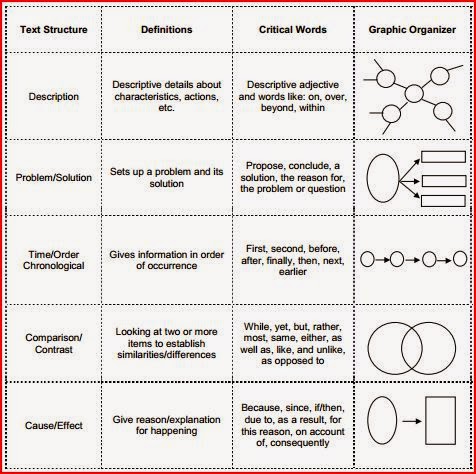
  • Various Text Structures of Informational Writing.  Informational writing doesn't really fall into any one structure.  It's a combination of structures.  This requires students to think in these ways about a text.  Students should be able to include description in some parts of the text, but also know when it's appropriate to include problem/solution, narrative (chronological), comparison and/or cause and effect.  It requires students to recognize how all the parts they include work together as a whole text.

  • Writing for an Audience.  Students need to be able to take their thinking from entries with notes and quick thinking to "writing long."  This requires free-writing to think through those big ideas and details that drove them there as well as structured writing that will make their ideas clear to a reader.

If my students can stash these in their writers' toolboxes, I know they can apply them in many different writing situations.  I'm guessing that as I work my way through this unit, I'll be adding to this post!


Wednesday, December 31, 2014

Reading & Writing Workshop on a Secondary Schedule -- Part 2

I wrote over the summer about my hope to have an authentic reading and writing workshop on my 42 minute schedule.  As I reread the post, I sure love my high hopes!

I am glad to say that although there are many obstacles, there are some pieces of workshop that I find falling into place, and these are pieces I plan to pour in concrete as I build this strong structure of instruction.

Classroom design has been my greatest accomplishment this year.  My students meet every day at the front of my room.  At first we met in a circle, but it was awkward because my class sizes are so big (nearing 30!) -- our circle couldn't include everyone.  So now we meet "movie theater style."  Students sit with assigned partners in assigned seats.  I used to be against this, but found that it is much more efficient for students to come to class and know exactly where to sit and who to sit next to.  Not all students are thrilled with their partners, but I make it clear we are there to learn and support each other.  Partners have a responsibility to each other, and in the future I plan to make this even stronger through community building (another area I need to strengthen, and will save that for future posts).

I work diligently to keep time at our "meeting" at 10-15 minutes, and then students move to their assigned seats to work independently and me time to conference.  I still struggle with coming back to share in our meeting, and mostly this happens as a whole group while students are at their tables.  All in all, it is the structure that I hoped for way back in that summer post.

What's Working With Workshop Structure in 42 Minutes

  • Having a meeting area.  This forces me to plan for minilessons that are short and focused on one skill.  We simply don't have time to move too quickly through multiple skills, which adds depth to our work as we master one objective at a time. 
  • Keeping a consistent structure.  Students move to work with a "signal" from me when the minilesson is over.  Something along the lines of "Ok, let's try this!" or "Time to get to work!" makes a smooth transition from guided practice to independent work.
  • Time to conference.  I love that I get time to move to individual students and small groups even though I only have limited time.  This really helps to differentiate where needed.
  • Classroom management.  Students know what to expect with the routine of the class.
What's Challenging With Workshop Structure in 42 Minutes
  • I have to let things go.  I simply am not able to fit in a full reading AND writing curriculum.  I constantly play tug-of-war with my conscience and balancing the top-priority of instructional objectives.  Which days are for reading instruction?  Which days are for writing?  Especially in my work with Calkins, in which a Literacy Block is assumed, I have to be very picky about what to keep and what to let go.  
  • Time.  I have one prep period in my day without students.  One period to plan, grade, evaluate, answer emails, contact parents, differentiate instruction, meet/plan with colleagues, use the bathroom, etc.  Workshop requires me to know where each individual student needs to go next, and 120 students is tough to do that with.  I have a life outside of work that is also a priority!
My Plans to Attack These Challenges
  • Be vocal.  As department chair, I plan to keep hounding my district about block scheduling.  We had this at one point, but by cutting the block my district was able to cut teachers.  The chances of getting teachers back is slim-to-none, but I won't stop trying!  Teachers also need time to work that doesn't involve students in the classroom.  This is a legitimate part of our job.
  • Being very reflective in my objectives.  With new Common Core curriculum, we are revamping everything.  As I experiment with pedagogy, instructional objectives, and curriculum I am keeping close notes about what is working and what isn't.  This will make planning next year even easier (I hope!).
  • Even more structure.  Although students know they are supposed to meet in the front of the room and sit with partners and be prepared for class, I still spend time waiting for students to get settled.  This wastes valuable instructional time.  As I learn about what works, I can see the weak areas to improve.
Does Reading and Writing Workshop work in 42 minutes?  I would have to give that a strong YES.  There are parts of an authentic workshop that have to be left behind, but at its core, it works!


Tuesday, December 30, 2014

Moving Students' Thinking Past Summary

When I first had students write about their reading, they mostly wrote paragraphs and summary.  When they explored other ways to respond, their responses were different:  charts, webs, and pictures . . . that were also mostly summary.  Ugh.

I needed to move their thinking deeper than this.  The resource I've been using, Writing About Reading:  From Reader's Notebooks to Companion Books, moves students right to noticing the details vs. big ideas they find in their entries, but my students' entries just summarized their books.  It seemed they weren't noticing any big ideas, and I needed to reshape the kinds of thinking they were doing.  I decided to take a detour lesson, and have students reflect on the kinds of thinking in their entries.

I started by sharing the three kinds of writing (not genres, but kinds of writing), and had students discuss with their partners what kind of writing they were doing in their reading notebooks.

Narrative
Argumentative
Informational

Our first unit this year had been narrative, so they were quickly able to choose informational and share reasons why.  Each student then taped the following chart into the back of their reading notebooks (this is where we take notes).
Types of Text Structures in Informational Texts
I briefly reviewed each structure, and associated it with a kind of thinking.  For example, in order to structure in "problem/solution" the writer needs to think about the problems and solutions.  We tried a couple of practice entries in which students decided what kind of thinking the writer did.

Then, I had students turn to their own notebooks.  What kinds of thinking were they doing most?  Students had to label each entry (at this point they had 5) with the kind of thinking presented there.  As I moved through the group and listened to conversations, I noticed exactly what I was hoping for:  students were labeling their entries as "description" over and over again.

When we returned to full group, we shared this.  We brainstormed ideas about how to think differently in our entries, added the ideas to our chart, and then set off to write entries in which the thinking was different.

Entry #6: Deliberately write an entry in which you think differently than your other entries.


Saturday, December 27, 2014

Writing About Reading as a Genre

The time between Thanksgiving and Christmas is always difficult.  Starting a unit that lasts more than 3 weeks is asking for trouble because so much momentum is lost over the holiday break.

I've been dabbling with Lucy Calkins' Units of Study and came across the unit Writing About Reading:  From Reader's Notebooks to Companion Books. Dabbling isn't the right word.  I'm enthralled in this unit!  I'm lucky enough to work in a district that finds great value in the work of Teachers College at Columbia University and the Reading and Writing Project, who developed these units.

For years I've known the importance of students writing their thinking about what they read.  This kind of writing is considered writing to learn, and requires readers to pay close attention to the books they are engaged with.  Writing about reading has never been authentic, though. Until now.

This Unit of Study suggests turning writing about reading into an authentic genre in the form of a companion book.  These books are found for many top-selling books, mostly ones that are made into movies:  The Hunger Games, Twilight, Star Wars.  There are may mentor texts for students to set their sites on when writing this way.  I knew I was stepping into unexplored territory with this unit, so decided to approach it as an experiment:  what works?  what's missing?  how will it fit into my year with the time I have and the structure of my schedule?

What I'm loving most about this Unit of Study is the scaffolding that's suggested. Immediately I found it easy to adapt to my 42 minute periods (although it's tough -- I have to make tough choices about how to balance reading and writing workshop since this unit of study is only writing). Students start with just writing -- workable with any structure.  I allowed students to choose their own books to write about, with the only requirement being that their choice is fiction.  I gave them prompts for Entry #1, in which they had to reflect on their book choice.  I started ideas from the unit of study with Entry #2, which is just to see what students will do; will they draw?  Write a paragraph?  Plot out a chart or web?  Will they draw a blank without a  prompt?  What I found is that most students wrote paragraphs.  Even when the assignment suggested other kinds of writing, most chose the paragraph, and all chose summary.  I had my work cut out for me.  How would I move their thinking in new directions with this genre?


Most initial entries were paragraphs and summary

The way the authors of this unit suggest to start moving students' thinking is to have a gallery walk.  Since there were a few of my students whose entries were not just paragraphs, I was able to just use my own classes' work for this strategy.

Gallery Walk:
  • Students set out their entries on the tables in the room (I don't have desks)
  • Students browse entries with a partner, answering the questions:
    • What are you noticing about the variety of responses?
    • What did other writers do that I could try too
Students return to a full group and share out.  Since I didn't have much variety in entries, I decided to chart responses and even had students add ideas.  We ended up with a chart of possible ways to respond to reading that weren't necessarily just a paragraph.  I left students with homework for entry #3:  this entry must be deliberately different than entry #1 & #2.

The results were awesome!  Even though I noted that responses were still mostly summary, students began branching out in the ways they respond -- a great direction for informational texts, that aren't written with paragraphs only.