Tuesday, December 30, 2014

Moving Students' Thinking Past Summary

When I first had students write about their reading, they mostly wrote paragraphs and summary.  When they explored other ways to respond, their responses were different:  charts, webs, and pictures . . . that were also mostly summary.  Ugh.

I needed to move their thinking deeper than this.  The resource I've been using, Writing About Reading:  From Reader's Notebooks to Companion Books, moves students right to noticing the details vs. big ideas they find in their entries, but my students' entries just summarized their books.  It seemed they weren't noticing any big ideas, and I needed to reshape the kinds of thinking they were doing.  I decided to take a detour lesson, and have students reflect on the kinds of thinking in their entries.

I started by sharing the three kinds of writing (not genres, but kinds of writing), and had students discuss with their partners what kind of writing they were doing in their reading notebooks.

Narrative
Argumentative
Informational

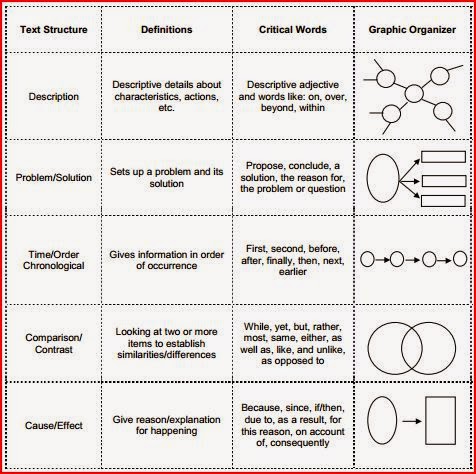
Our first unit this year had been narrative, so they were quickly able to choose informational and share reasons why.  Each student then taped the following chart into the back of their reading notebooks (this is where we take notes).
Types of Text Structures in Informational Texts
I briefly reviewed each structure, and associated it with a kind of thinking.  For example, in order to structure in "problem/solution" the writer needs to think about the problems and solutions.  We tried a couple of practice entries in which students decided what kind of thinking the writer did.

Then, I had students turn to their own notebooks.  What kinds of thinking were they doing most?  Students had to label each entry (at this point they had 5) with the kind of thinking presented there.  As I moved through the group and listened to conversations, I noticed exactly what I was hoping for:  students were labeling their entries as "description" over and over again.

When we returned to full group, we shared this.  We brainstormed ideas about how to think differently in our entries, added the ideas to our chart, and then set off to write entries in which the thinking was different.

Entry #6: Deliberately write an entry in which you think differently than your other entries.


Saturday, December 27, 2014

Writing About Reading as a Genre

The time between Thanksgiving and Christmas is always difficult.  Starting a unit that lasts more than 3 weeks is asking for trouble because so much momentum is lost over the holiday break.

I've been dabbling with Lucy Calkins' Units of Study and came across the unit Writing About Reading:  From Reader's Notebooks to Companion Books. Dabbling isn't the right word.  I'm enthralled in this unit!  I'm lucky enough to work in a district that finds great value in the work of Teachers College at Columbia University and the Reading and Writing Project, who developed these units.

For years I've known the importance of students writing their thinking about what they read.  This kind of writing is considered writing to learn, and requires readers to pay close attention to the books they are engaged with.  Writing about reading has never been authentic, though. Until now.

This Unit of Study suggests turning writing about reading into an authentic genre in the form of a companion book.  These books are found for many top-selling books, mostly ones that are made into movies:  The Hunger Games, Twilight, Star Wars.  There are may mentor texts for students to set their sites on when writing this way.  I knew I was stepping into unexplored territory with this unit, so decided to approach it as an experiment:  what works?  what's missing?  how will it fit into my year with the time I have and the structure of my schedule?

What I'm loving most about this Unit of Study is the scaffolding that's suggested. Immediately I found it easy to adapt to my 42 minute periods (although it's tough -- I have to make tough choices about how to balance reading and writing workshop since this unit of study is only writing). Students start with just writing -- workable with any structure.  I allowed students to choose their own books to write about, with the only requirement being that their choice is fiction.  I gave them prompts for Entry #1, in which they had to reflect on their book choice.  I started ideas from the unit of study with Entry #2, which is just to see what students will do; will they draw?  Write a paragraph?  Plot out a chart or web?  Will they draw a blank without a  prompt?  What I found is that most students wrote paragraphs.  Even when the assignment suggested other kinds of writing, most chose the paragraph, and all chose summary.  I had my work cut out for me.  How would I move their thinking in new directions with this genre?


Most initial entries were paragraphs and summary

The way the authors of this unit suggest to start moving students' thinking is to have a gallery walk.  Since there were a few of my students whose entries were not just paragraphs, I was able to just use my own classes' work for this strategy.

Gallery Walk:
  • Students set out their entries on the tables in the room (I don't have desks)
  • Students browse entries with a partner, answering the questions:
    • What are you noticing about the variety of responses?
    • What did other writers do that I could try too
Students return to a full group and share out.  Since I didn't have much variety in entries, I decided to chart responses and even had students add ideas.  We ended up with a chart of possible ways to respond to reading that weren't necessarily just a paragraph.  I left students with homework for entry #3:  this entry must be deliberately different than entry #1 & #2.

The results were awesome!  Even though I noted that responses were still mostly summary, students began branching out in the ways they respond -- a great direction for informational texts, that aren't written with paragraphs only.


Monday, December 22, 2014

It Really Is All In the Details!

I've been setting some new foundations this year for our units of study.  I've thought a lot about what I want the enduring skills that will thread through each unit this year will be, and Falling in Love With Close Reading has really helped me with some of those ideas.

The first is the idea of having a reading "ritual."  My students get a kick out of this, asking me when we'll be sacrificing the chicken, but the idea that a ritual is much like an ingrained routine that one just expects or does without really realizing it is important with the reading and writing work we'll do this year.  It's especially important when doing the work of a close reader.

So far, I've had students working on the steps to this:
From Falling in Love With Close Reading page 12


We labored through each step using Of Mice and Men with eighth grade, and the short story "LAFFF" by Lensey Namioka with seventh.  When the "steps" to this ritual were individualized, students did great!  But, when asked to put them all together . . . disaster.  Hmmm.  There's no point in reading the details closely and finding patterns and relationships if a greater understanding doesn't occur.  Students are missing the point of our "ritual."

As I try this myself as a reader, I notice that I often overlook details that really do deepen my understanding.  Without these details, I still get the gist of the text, but don't have the understanding that makes me love to read.  Simple as that.

Thursday, October 2, 2014

How is reading like a conversation? Establishing big understandings first.

My husband is building his dream garage.  It's huge, has room for a lift, has an upstairs space for storage, and is placed strategically so he has space around it for car storage and parts.  Before we even cleared the first tree, he had a vision of what he wanted the garage to look like, and what he'd be able to accomplish because of how it was built.  When we finally did get to pouring the foundation, it was meticulously set in order to support that vision of the finished building.


This year I'm taking my husband's lead and having a vision of what I want my classroom to look like and accomplish.  It means having that "finished product" in mind, but knowing what pieces need to be put in place in order to make the dream happen are essential as a foundation.


One of those pieces is the comparison of reading to a conversation with the author.

I've adopted this approach after reading (and rereading. . .and rereading) Falling in Love With Close Reading by Christopher Lehman and Kate Roberts. In it, the authors muse:
"We all yearn to be understood.  We want a smile of recognition, a nod of heads in agreement, the feeling of community and connection that being truly understood brings."  What a great connection to misunderstood middle schoolers! And what a great way to bring this idea to reading: "Texts strive to be understood I need much the same way. Authors thoughtfully select details, hoping we, the readers, are listening."

Looking no further than self-as-a-reader, Lehman and Roberts align close reading to a ritual, one that can be seen in action even as you read this post:
1.  Read with a lens -- pull specific details based on the lens
2.  Find a pattern -- look over those details to see which fit together and how
3.  Grow understandings -- use the patterns to see the "big ideas" in the text

Possibly the simplest, yet to me most profound, statement in this book is the suggestion that teachers often have students make a claim and then find details/evidence to support it, when really readers don't work that way.  Readers need to use the details to build the claim.

With these ideas in mind I'm beginning my first unit of study with my 7th and 8th graders.  We are calling these steps our "reading ritual" with the expectation that eventually the steps will be as second nature as our morning get-ready-for-school routines.


Thursday, September 4, 2014

Classroom Design: Essential to Reading/Writing Workshop Framework

I decided to go back to my roots.

When I began teaching, I was blown away by Nancie Atwell's In the Middle and began to implement everything I could about her workshop method.  Pretty gutsy for such a green teacher, but ignorance was bliss and I fell in love with the connection to students as readers and writers.  Fast forward fifteen years, and there I am, still in the classroom, but with a lot more experience and knowledge in my noggin.  Over the past couple of years, I've found myself moving away from those In the Middle experiences, and I'm sad about that.

So, I decided to take action.

It's been quite a while, but I designed my classroom to support the framework I know to be best for my students.  

In my training through Literacy Collaborative, I learned, practiced and implemented a gradual release model of instruction.  This is nothing new, but a fresh reminder of how students learn.  The LC classrooms I visited had a separate meeting area for the "I do" and sometimes "We do" portion of the lesson, and then another space for students to work independently.  Not only did this make the structure of the lesson reliable and tangible for students, it helped the teacher plan in a particular way, knowing a meeting would be taking place to take a look at a certain skill.  

After some deliberation and work with Classroom Architect, I found a classroom design I can start my year with. This design supports the structure of my lessons and an environment of collaboration.

The front of my room has become the "meeting area" where class begins each day.


The back of my room holds my classroom library, a bulletin board waiting to be filled, and tables for students to complete independent work.

Another view of the clusters of tables.  A shelf separates the "meeting" area from the "work" area.

I can't take credit for this hanging over my door this year.  I stole it from this post by Pernille Ripp.


Now all that needs to be added to this classroom is students!  That always seems to be the true test of a classroom design.

Tuesday, August 26, 2014

What is ELA, Really?

ELA.  English-Language Arts.  Ages ago when I was a middle school student, ELA meant that I was assigned a book, I took quizzes on its content, and then moved on to the next text.  I took quizzes and tests in grammar and spelling in the same way.  "Reading" meant memorizing the plot of a story and listening to my teacher tell me its deeper meaning.  "Writing" meant having correct spelling and grammar as well as 5 paragraphs in my so-called essay (about what I was assigned to read).  Somehow it got me through; I found my way to being an English teacher despite my dull experience.

It's taken me a long time to figure out why it's so difficult to teach English-Language Arts.  It's because it's such a gray content area.  Math clearly defines the exact skills students are to learn each year.  Clear-cut.  No frills.  Either a student gets it, or he doesn't.  Science and Social Studies are the similar:  teach this topic and this topic and this topic.  Yeah, yeah, yeah -- these content areas are supposed to teach reading and writing too, but we all know that the brunt of that goes to ELA:  that big GRAY elephant in the room.

An example from the Common Core Standards:


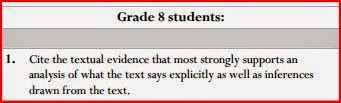
Did the student cite textual evidence?  Yes.  Does that evidence strongly support and analysis of what the text says explicitly?  Uhhhh . . . maybe?  Kind of?  That's a pretty relative statement!  It takes a lot of thinking to push through what ELA is really  meant to teach students.  ELA has moved from the content of texts to the literacy skills it takes to read them.  Consider this from EngageNY:


Whoa.  That's a far cry from the education I experienced!

As I move through this school year, I hope to continually revisit the gray areas of my content area and make them a bit more concrete.  I hope to notice and name the skills in literacy that push students to "readily undertake the close, attentive reading that is at the heart of understanding and enjoying complex works of literature."  Most of all, I want my students to be able to say "I get it."


Monday, August 18, 2014

Reading Workshop: Making it happen with limited time

I've been working recently with how to structure and organize, as authentically as possible, Reading and Writing Workshop into my 42 minute periods of 7th and 8th grade ELA.  I've decided to start wrapping my brain around Reading Workshop, since it's where I feel most at home.  I view myself as a reader, and have somewhat successfully implemented Reading Workshop over the past few years.

After some thought, I believe these experiences are essential to a Reading Workshop:

  • Strict adherence to the Rules of Reading Workshop
  • Self-selecting books (with some guidelines . . . thanks to Calkins for pushing my thinking on this)
    • reflecting on self as a reader in order to grow
  • Individual conferences and small (temporary and homogeneous) group work
  • Writing about reading 
    • Reader's Notebook
    • various purposes for writing about reading
  • Discussions about reading with other readers
  • Read-alouds
  • Study the craft of writing
  • Study the characteristics of genre
Wow.  42 minutes.  Where to begin?

To start my year, I will assume most students have not been in a Reading Workshop setting since elementary school.  That means much of these structures will need to be revisited, if not retaught/re-established as routine.  With this forethought, the beginning week(s) of my year might look like this:


First Day:  Intro to Reading & Writing Workshop
I like to spend my first day with students as orientation and organization.  Students need to have a permission slip signed that allows them to create Google and Goodreads accounts, and get an overview of what their year in ELA will entail.  I also introduce the classroom library, filing systems, and the narrative assessment to be given the next day.  Students complete interest inventories for reading, writing, and technology.

Narrative Assessment:
This year we are rewriting curriculum K-12 in our district to better align with Common Core Standards.  ELA is focusing on genre studies, and our department has decided upon narrative as our foundation piece for the year.  I believe this is a great decision (more on that when I starting thinking through how to bring Reading and Writing Workshops together into Genre Study).  Needless to say, 7th and 8th grades are given a pre-assessment to see just what our kids know about writing narratives.  This will take the entire class period, and give us oodles of information about where to take our instruction.

Launching Reading Workshop
I'm a huge believer that all stakeholders in my classroom are required to have a say about what happens with the time we spend together.  It is essential that students collaborate in the creation of the rules and structures of Reading Workshop.  Our understandings and expectations from each other should not be top secret!  It's often eye-opening to hear what students expect from me and from themselves (and each other!).  This lesson is dedicated to establishing the groundwork of our workshop.  I collect ideas from each of my 5 classes throughout the day, and then share the best thinking to carry us through our year.  Also this day, we journey to the library to start choosing independent books.  This is not new for most students, and although I know there will be a few reluctant and struggling readers who fight me on this, I will begin to create a vision about our work together as readers.

Creating Reading Habits & Structure of Reading Workshop
I listed "Rules for Reading Workshop" today as a bit different that the "rules" we came up with together. Students have much say as to the environment they will work in, but when it comes to the instruction that will push them to my high expectations -- I set the rules.  This class is dedicated to the "set-up" of tools we'll need to push ourselves as readers.  These rules include the following requirements and assignments:

  • Goodreads.  Mandatory amount of reading (to be determined as the year progresses).  Reflection on self as reader.
  • Reading:  The expectations I have for students as readers this year are to 
    • Read:  Both self-selected and assigned texts and for a variety of purposes
    • Write About Reading for a variety of reasons
    • Discuss Your Reading with me as well as peers
For this first Unit of Study, I'd like the main focus to be reflection.  This habit makes growth possible.  Tools that will help students reflect are:

      • Goodreads:  Students will create (or continue) a Goodreads account.  This marking period they will simply track their reading progress and begin reflecting on themselves as readers  Students must finish at least one book by the beginning of our narrative Unit of Study (tentatively Sept. 29).  
      • Reader's Notebook:  Students will write about their reading, at first, to participate in discussion with a partner or whole group about our shared text.  I particularly like What Readers Really Do by Dorothy Barnhouse and Vicki Vinton. They outline a process that requires me to reflect on what I do as a reader in order to teach students what readers do to make meaning.  I anticipate those minilessons in a later post as they occur.
My vision for this week is to strongly establish the foundational pieces of my 42 Minute Reading Workshop: ~  Illustrative Example-"Have a Go"-Application-Share (how our 42 minutes are structured)
~  Proficiency with Goodreads so it can be moved to an "outside of class" assignment
~  Regular use of Reader's Notebooks as a tool to support reading
~  Becoming a better reader by reading

I will also be collecting a great deal of data about my students.  I like to use this time to have each student experience a conference with me and establish my standards.  I jot many notes about what I see readers doing and saying, and begin to plan the minilessons for our first "official" unit of study:  Narrative.
Fingers crossed!